Frida Kahlo.
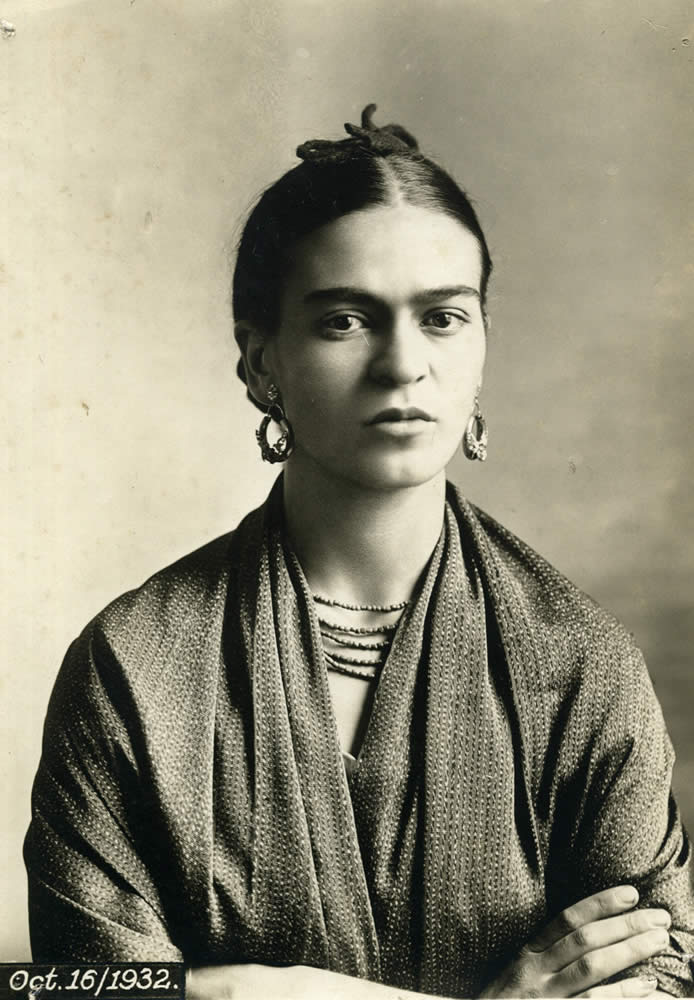
Frida Kahlo painted the body as territory. Between the streetcar accident of 1925 and her death in 1954, she built a body of work of little more than one hundred and fifty canvases, mostly small self-portraits, in which physical pain, Mexican identity and desire are bound together without ever yielding to sentimentality.
Born in Coyoacán, on the edge of Mexico City, she taught herself to paint during the long convalescence that followed the accident. Her entry into muralism, through Diego Rivera (whom she married twice), never drew her away from the intimate format or from the grammar of the popular ex-voto, which she raised to the level of a modern language.
André Breton wanted to claim her for Surrealism; she replied that she had never painted dreams, only her own reality. Her solo exhibition in Paris in 1939, and the first on Mexican soil in 1953, when she was already gravely ill, sealed in her lifetime a recognition the following century would turn into myth.
Galeria Harmonia has followed the presence of Kahlo's work on the secondary market since 2016, with particular attention to the self-portraits of the early 1940s.
Selected works.
Across the index, works are held as fields of color. The full reproduction opens on each work's own page; where a painting remains under copyright, its entry stands in for the image.
-
2026Geometrias
Insubmissas.Galeria Harmonia, São Paulo -
2023Frida:
o corpo como territórioGaleria Harmonia, São Paulo -
2021Modernas:
três países, uma rupturaGaleria Harmonia, São Paulo -
2017Frida
em São PauloGaleria Harmonia, São Paulo -
1998Modernismo
InsurgenteGaleria Harmonia, São Paulo (inaugural)